
Response to the TCFD recommendations
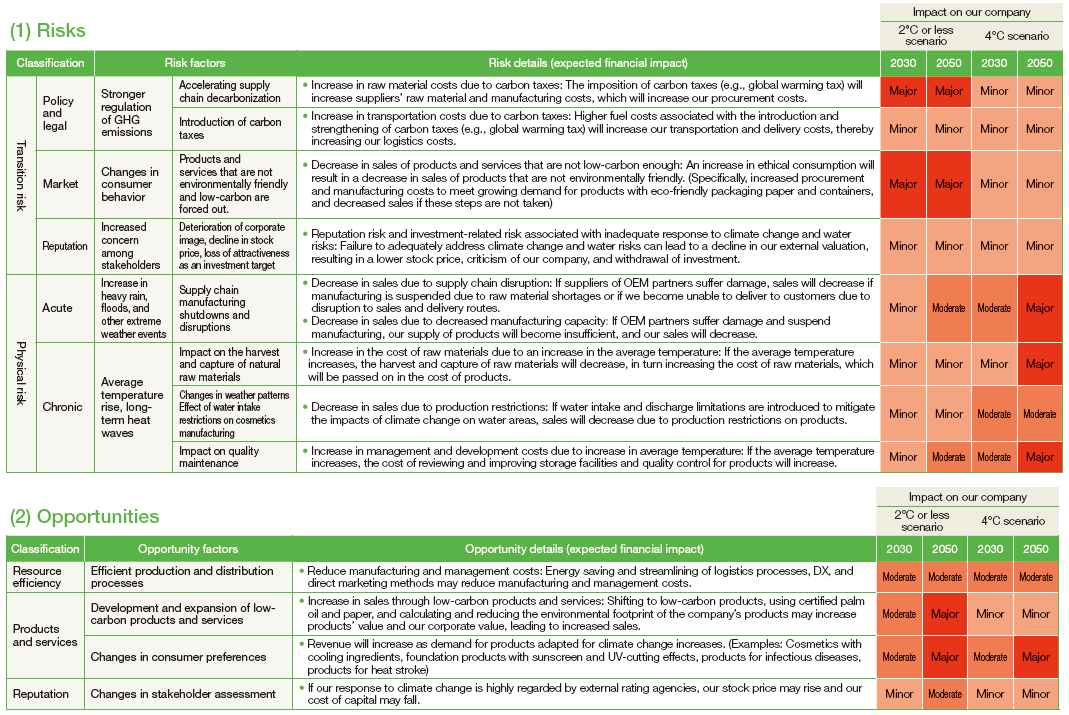
We have comprehensively identified and analyzed the physical and transition risks associated with climate change. By working to reduce these risks and create business opportunities, we are enhancing our resilience as a company and promoting our response to climate change as an important management priority.

Support for the TCFD recommendations
We declared our support for the TCFD (Task Force on Climate-related Financial Disclosures) recommendations in October 2022. Since then, we have continuously worked to enhance our disclosure of climate-related information based on the TCFD recommendations.
Governance
Climate-related risks and opportunities are discussed by the Sustainability Committee.
The Sustainability Committee is chaired by the President & Representative Director of the Board and Chief Executive Officer and consists of Directors of the Board (excluding part-time Directors and Directors who are Audit & Supervisory Committee Members), Senior Executive Officers, Executive Officers, and department managers. The Committee identifies climate-related risks and opportunities, analyzes their potential impacts, and examines measures to address them, and reports the matters discussed to the Board of Directors.
In addition, risks that may have a significant impact on our business, including climate-related risks, are reviewed and discussed by the Sustainability Committee and the Risk Management and Compliance Committee, and the results are reported to the Board of Directors.
Strategy (Scenario Analysis)
We conducted scenario analyses for the years 2030 and 2050, assuming two different temperature ranges of 2°C or less and 4°C or more as future temperature rise scenarios. The materiality assessment and financial impact analysis are conducted with reference to scenarios disclosed by government agencies and research institutes shown in the table below.
| Scenario Overview | Reference Scenarios | |
|---|---|---|
| 2°C or less scenario | A scenario in which stricter climate change measures than the status quo are taken and global average temperature increase is limited to less than 2°C. | RCP2.6 by IPCC NZE2050,SDS4℃ by IEA |
| 4°C scenario | A scenario in which no climate change measures are taken beyond the status quo and the global average temperature rises by about 4°C. | RCP8.5 by IPCC |
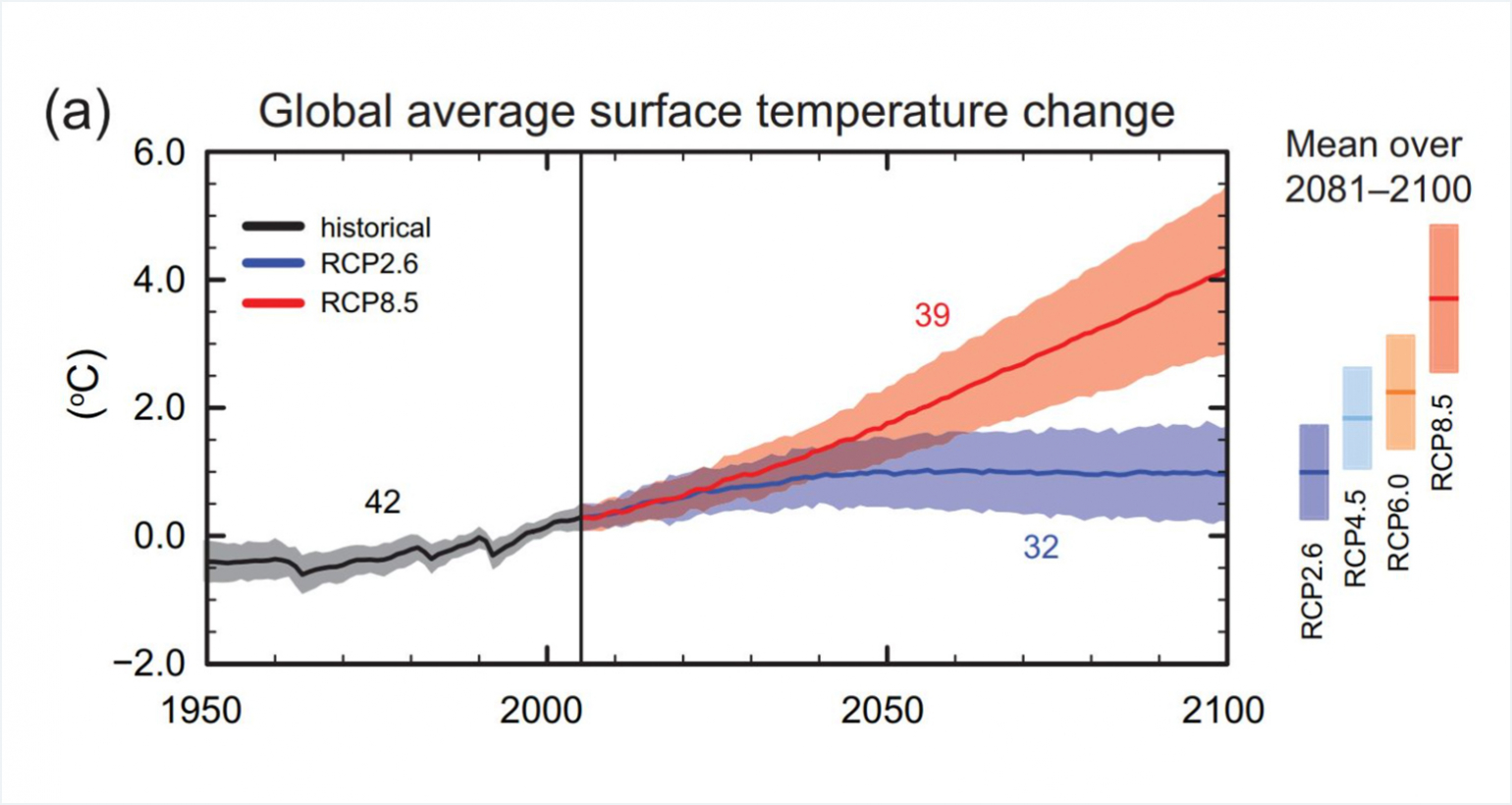
List of identified climate-related risks/opportunities and severity assessment
Risk Management
Under the Sustainability Committee, we identified climate-related risks and opportunities. For the identified risks, we are promoting company-wide risk management, including formulating policies and planning measures to reduce risks, centered on the Sustainability Committee and the Risk Management and Compliance Committee. We also continuously monitor the implementation status and effectiveness of these measures.
Metrics and Targets
As indicators for promoting our response to climate change, we calculate and manage greenhouse gas emissions (Scope 1, Scope 2, and Scope 3). With the goal of achieving carbon neutrality by 2050, we are analyzing the greenhouse gas emissions we have calculated and developing concrete initiatives to reduce the environmental impact of our business activities. Going forward, based on the results of our emissions analysis and the business environment, we will consider setting medium- to long-term reduction targets and contribute to the realization of a decarbonized society.